

📉 Why the Highest Valuation Isn’t Always the Best One
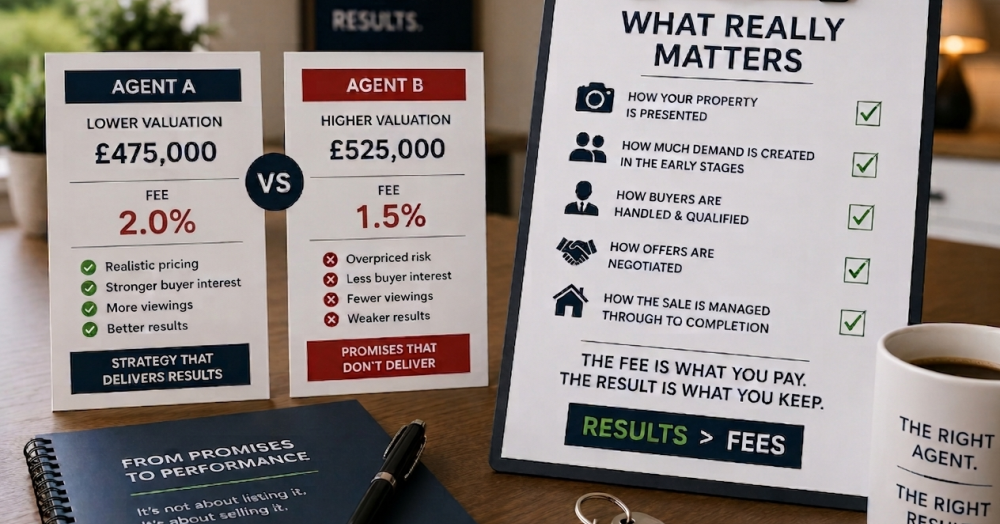
When inviting estate agents out to value your home, it’s completely natural to be drawn towards the highest figure. After all, on paper it looks like the best outcome — more money, better result.
But in reality, the highest valuation is not always the one that delivers the best sale.
In fact, in many cases, it can have the opposite effect.
The Risk of Overpricing
Buyers today are extremely well-informed.
They monitor the market constantly, compare properties daily, and quickly identify when something feels overpriced.
If a property is launched above what the market considers fair value, it tends to generate:
- Less initial interest
- Fewer viewings
- Longer time on the market
And this is where the real issue begins.
Because the first few weeks of marketing are the most important.
That initial launch period is where the highest level of buyer attention exists. It’s when your property is fresh to market, appearing in new listings, and generating the strongest emotional response from buyers actively searching.
If that initial wave of interest is missed, it’s very difficult to recreate later.
But forget the data for a moment. Think about it from a buyer’s perspective.
You’re searching for a home. You come across a property that’s been on the market for three months. It’s had one price reduction. Maybe two. Maybe three.
What’s your honest first thought?
- Something must be wrong with it.
- They must be desperate.
- There’s room to negotiate.
That’s not assumption — it’s exactly what we hear from buyers every single day.
The moment a property sits on the market too long, the narrative changes. Buyers stop wondering how quickly they need to act and start wondering how low the seller might go.
And once that perception takes hold, it’s incredibly difficult to reverse.
The seller who originally chased a higher number often ends up negotiating from a far weaker position than if the property had been priced correctly from day one.
What Happens Next?
Typically, an overpriced property follows a very predictable pattern:
- It launches at a strong figure
- Interest is slower than expected
- Viewings are limited
- Price reductions follow
- Buyers begin asking, “What’s wrong with it?”
By the time the property reaches the price it realistically should have launched at, it’s no longer seen as a fresh opportunity.
It becomes a property buyers feel they’ve already dismissed once before.
And that often leads to weaker offers, longer negotiations, and a worse final outcome than if it had been positioned correctly from the start.
The Psychology of Pricing
A strong pricing strategy isn’t about aiming high and hoping for the best.
It’s about positioning your property where it creates the maximum amount of interest immediately.
Because interest creates viewings. Viewings create competition. And competition is what drives the best price.
The strongest results often come from properties that feel well-positioned in the market from day one — properties that create urgency, generate multiple interested buyers, and put the seller in control of the negotiation.
That’s where the best leverage exists. Not when you’re chasing the market down with reductions weeks later.
Honest Advice vs Easy Promises
Some agents will give a higher valuation because they know it’s what sellers want to hear.
But there’s a huge difference between winning an instruction and successfully selling a property.
A good agent will base their advice on:
- Current market conditions
- Comparable evidence
- Buyer demand within your price range
- A clear launch and negotiation strategy
Even if that advice is more realistic than optimistic. Because the goal shouldn’t be to tell a seller the highest number possible. The goal should be to create the strongest possible outcome.
Final Thought
The goal isn’t to list your property at the highest possible price. It’s to sell your property for the best possible price. And those two things are not always the same.
The right pricing strategy doesn’t reduce your chances of achieving a premium result — it increases them.
Because the best outcomes usually come from creating momentum early, generating competition, and negotiating from a position of strength.
Not from sitting on the market hoping the market eventually catches up.